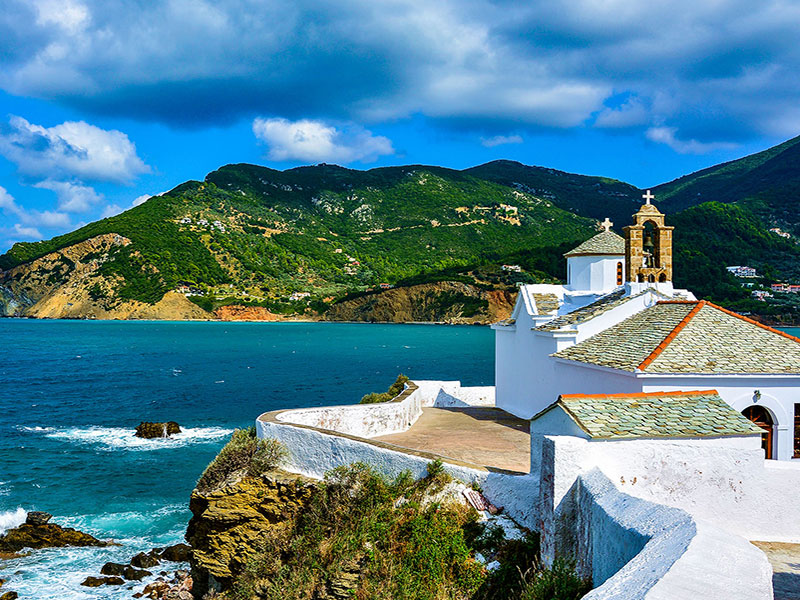
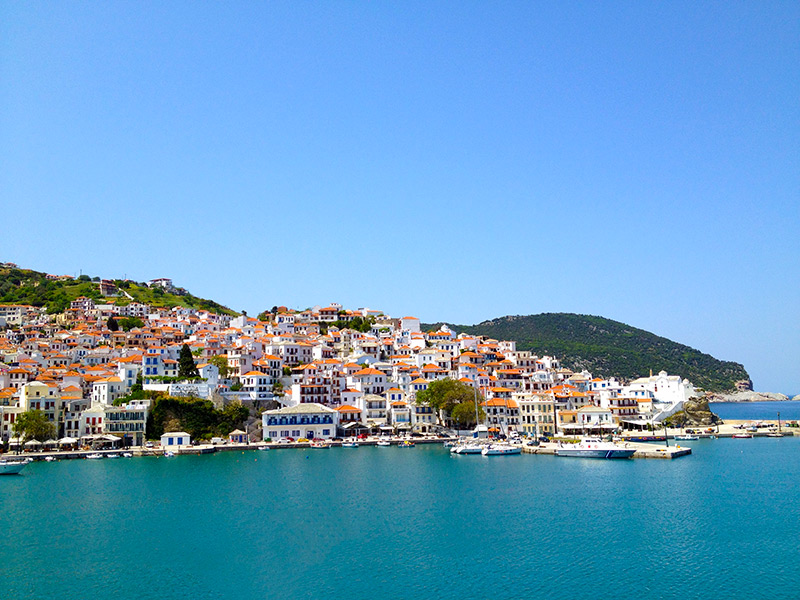
In legend, Skopelos island was founded by Staphylos or Staphylus (Greek for grape), one of the sons of the god Dionysos and the Princess Ariadne of Crete. Historically, in the Late Bronze Age Skopelos, then known as Peparethos (Πεπάρηθος) or Peparethus, was colonised by Cretans who introduced viticulture to the island.
Perhaps because of the legend of its founding by the son of the god of wine, the island was known throughout the ancient Greek cities of the Mediterranean Sea for its wine. The play Philoctetes (first performed at the Festival of Dionysus in 409 BC) by Sophocles includes a wine merchant lost on his way to «Peparethos – rich in grapes and wine».
In 1936 excavations in the area of Staphylos / Velanio uncovered a royal tomb of the era of Mycenaean Greece. The island was briefly under the control of the city-state Chalcis, Euboea since at least the 8th century BC.
In turn the island would come under the political influence or direct domination of:
- Athens.
- The Kingdom of Macedon (338 – 146 BC).
- The Roman Republic (146 – 27 BC).
- The Roman Empire (27 BC – 330 AD).
- The Byzantine Empire (330 – 1204).
- The Republic of Venice (Duchy of the Archipelago) known as Scopelo (1204 – 1538).
- The Ottoman Empire (1538 until the Greek War of Independence).
Skopelos became part of the First Hellenic Republic under the London Protocol confirming its sovereignty (3 February 1830).
During World War II, Skopelos fell under Axis occupation. At first it was occupied by the Kingdom of Italy (June 1941 – September 1943) and then by Nazi Germany (September 1943 – October 1944). Skopelos and the rest of Greece returned to democratic style government in 1944.